
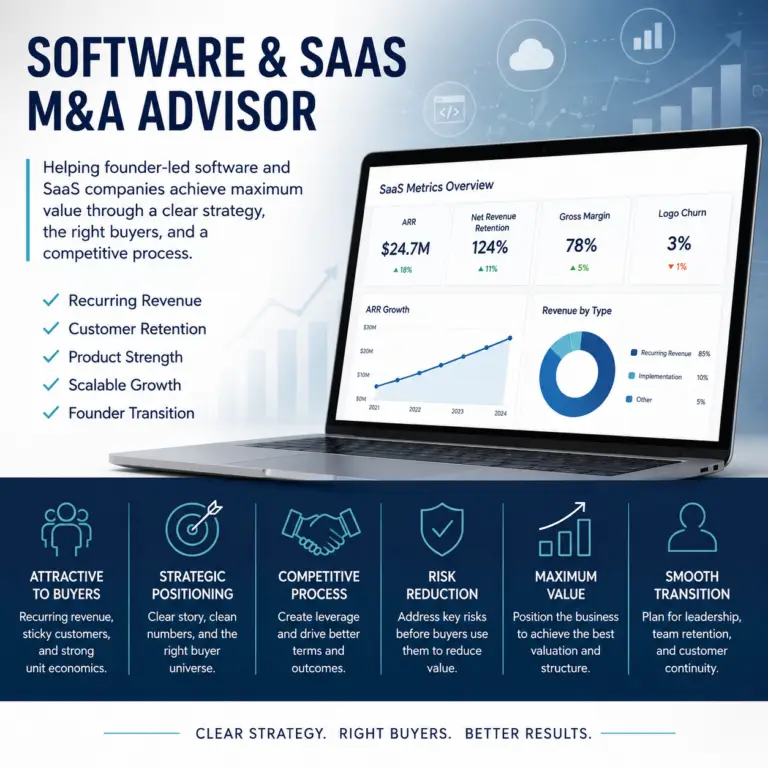
Software & SaaS M&A Advisor
Selling a software company is not just a financial transaction. Buyers are trying to understand whether the revenue is durable, whether the product is important to customers, whether the company can grow, and whether the business can operate after the founder steps back.
I work with founder-led software and SaaS companies where the buyer story needs to be clear before the company is introduced to the market. In software, that means organizing the facts buyers care about: ARR, renewal history, retention, gross margin, customer concentration, product roadmap, implementation effort, technical depth, and the role of the owner.
The strongest software sale processes are not built around slogans. They are built around evidence. Buyers want to know what the company really owns: recurring customer relationships, a product that solves a meaningful problem, revenue that can be verified, and a team that can support the business after closing.
The types of software companies this page covers
This page covers B2B SaaS, vertical software, license and maintenance software, usage-based platforms, software plus services companies, data and workflow platforms, and legacy software companies with long-term customer relationships.
The label matters less than the economics. A company can call itself SaaS, but buyers will look at the actual revenue model. They will separate subscription revenue from implementation revenue, support, customization, professional services, reseller revenue, and one-time projects.
How buyers think about software companies
Buyers usually start with four questions. Is the revenue recurring or at least highly repeatable? Do customers stay and expand? Can the product and customer base continue without the founder? Is there a credible growth path after closing?
A smaller software company with clean recurring revenue, low churn, and a capable team can be more attractive than a larger company with weak metrics, messy reporting, high customer concentration, and founder-owned product knowledge. Buyers are not simply buying code. They are buying customer retention, workflow control, revenue quality, and the ability to grow.
What makes a software company more valuable
- Recurring or highly repeatable revenue that can be traced by customer and contract.
- Low churn and a clear explanation for why customers stay.
- Strong gross margins that support software economics.
- A focused market position, especially in a vertical or mission-critical workflow.
- Low customer concentration and a diversified customer base.
- Clean ARR or MRR reporting that excludes one-time services and pass-through revenue.
- Product documentation, roadmap discipline, and an engineering team beyond one founder or contractor.
- A sales process that does not depend entirely on the founder.
- Customer success, onboarding, and support processes that are repeatable.
- A second layer of management or team leads who can operate the business after closing.
Issues that reduce buyer interest
The risks buyers usually test are weak retention, unclear ARR definitions, customer concentration, technical debt, founder-owned product knowledge, services revenue presented as software, and a product that requires heavy customization for each customer. None of these issues automatically prevents a sale, but they often affect valuation, structure, transition expectations, or the amount of cash paid at closing.
The biggest mistake is waiting for buyers to discover these issues during diligence. If there is a weakness, it should be understood, framed, and addressed before buyers use it to reduce value.
What sellers should prepare before going to market
- ARR or MRR schedule and clear definition of what is included.
- Revenue by customer, product, service line, and month.
- Gross revenue retention, net revenue retention, logo churn, and revenue churn.
- Customer concentration by revenue and gross margin.
- Contracts, renewal terms, cancellation rights, and assignment language.
- Deferred revenue, backlog, implementation obligations, and support commitments.
- Product roadmap, technical architecture, documentation, and known technical debt.
- Engineering, product, sales, customer success, and support team roles.
- Sales pipeline, historical bookings, win rates, and source of new revenue.
- Owner role and transition plan.
How I help
My role is to position the business clearly, identify the right buyer universe, create competitive tension, and help the seller avoid letting one buyer define the entire process. For software companies, that means translating the business into the language serious buyers use: revenue quality, retention, product durability, owner transferability, growth opportunity, and buyer fit.
The goal is not to make every company sound like a perfect SaaS platform. The goal is to present the company honestly and intelligently so buyers can underwrite it, compare it to other opportunities, and make serious offers.
Related Articles
- SaaS Valuation: ARR vs EBITDA
- What Buyers Look for in SaaS Companies
- Preparing a SaaS Company for Sale
- Vertical Software M&A Advisor
- Selling a Founder-Led Software Company
- Legacy Software Company M&A
- Software Plus Services Businesses
- Strategic Buyers for Software Companies
- How Buyers Value Recurring Revenue Service Businesses
- EBITDA vs SDE in Lower Middle Market M&A
- Owner Dependence and Business Value
- Customer Concentration and Business Valuation
- Why One Buyer Is No Buyer
Next Steps
If you own a founder-led software or SaaS company and are considering a sale, the best first step is a confidential conversation about buyer fit, valuation range, and what should be cleaned up before going to market.
FAQ
Do buyers value software companies on revenue or EBITDA?
It depends on growth, retention, profitability, size, and buyer type. High-growth SaaS companies may receive more focus on ARR or revenue multiples. Mature or slower-growth software companies are usually evaluated using both recurring revenue quality and adjusted EBITDA.
Does a software company need to be pure SaaS to sell?
No. Buyers may be interested in license and maintenance revenue, software plus services, usage-based platforms, or legacy products if the revenue is durable and the customer base is valuable. The key is explaining the revenue mix clearly.