
Preparing a SaaS Company for Sale
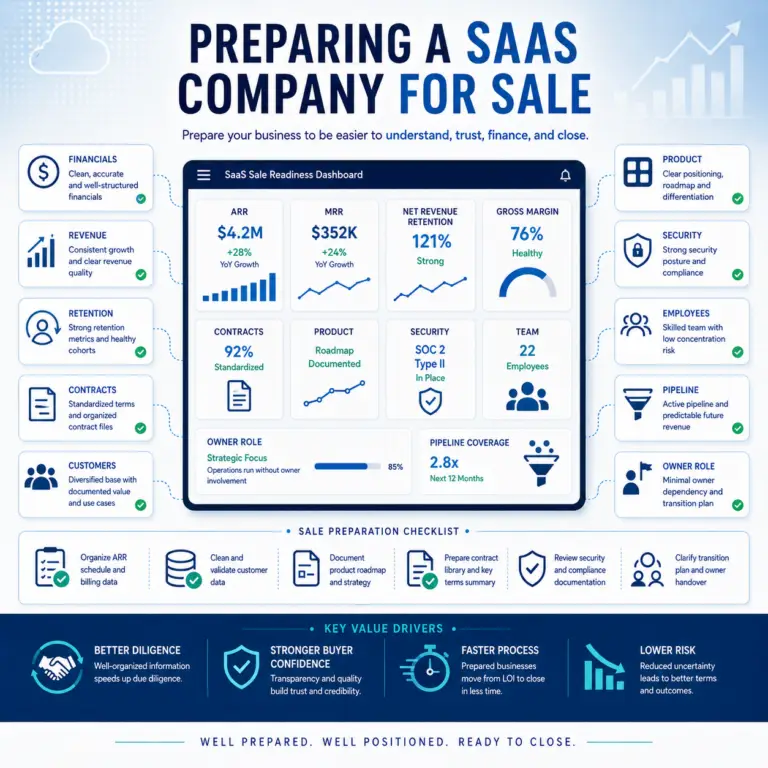
Preparing a SaaS company for sale is not about dressing it up. It is about making the business easier for a serious buyer to understand, trust, finance, and close. The best preparation reduces uncertainty before buyers use that uncertainty to reduce price or change terms.
Plain-English definition
Preparing a SaaS company for sale means organizing the financial, customer, product, technical, employee, and contract information a buyer will need to evaluate the business. It also means identifying issues that could slow diligence, create mistrust, or give a buyer leverage after the LOI.
When it matters
Preparation matters most before exclusivity. Once a seller signs an LOI and grants exclusivity, the buyer has more leverage. If a problem arises later, the buyer may request a price reduction, a seller note, an earnout, a working capital adjustment, a longer transition, or more protective indemnity terms.
How buyers think about preparation
Buyers use preparation as a proxy for business quality. Clean information does not guarantee a premium valuation, but disorganized information creates doubt. If a SaaS company cannot explain ARR, churn, retention, customer concentration, gross margin, product roadmap, or owner role, buyers start wondering what else is unclear.
What to organize first
- Financials: monthly P&L, balance sheet, TTM results, add-backs, and adjusted EBITDA bridge.
- Revenue: ARR schedule, MRR bridge, revenue by customer, revenue by product, and revenue by service line.
- Retention: gross revenue retention, net revenue retention, logo churn, revenue churn, and churn reasons.
- Contracts: renewal dates, cancellation rights, assignment language, pricing terms, and deferred revenue.
- Customers: top customer concentration, tenure, expansion history, usage, contacts, and relationship owner.
- Product: roadmap, release history, technical architecture, integrations, and known technical debt.
- Security: SOC 2, data privacy, backup, disaster recovery, customer security requirements, and incident history.
- Employees: roster, roles, tenure, compensation, key-person risk, and contractor dependencies.
- Pipeline: bookings, win rates, sales cycle, source of leads, and expansion opportunities.
- Owner role: where the founder is still essential and how the transition would work.
Example
Two SaaS companies each generate $5 million of ARR. One seller can provide clean ARR schedules, cohort retention, customer-level revenue, contracts, support metrics, product documentation, and a clear transition plan. The other seller has tax returns, scattered spreadsheets, unclear churn, and no reliable customer revenue history. The second company may still be good, but the buyer has to reconstruct the story. That usually affects speed, leverage, and sometimes price.
Common seller mistake
The biggest mistake is waiting until a buyer asks for information. By then, the seller is reacting. A better approach is to anticipate diligence and prepare the core materials before the process starts. Another mistake is hiding weaknesses. Serious buyers usually find them. It is better to understand the issue, explain it clearly, and show whether it has been addressed.
SaaS sale preparation checklist
- Monthly financials for the last three years and trailing twelve months.
- ARR and MRR schedules with clear definitions.
- ARR bridge showing new, expansion, contraction, churn, and price increases.
- Revenue by customer, month, product, and service line.
- Gross margin by subscription, services, support, implementation, and other revenue.
- Customer contracts, renewal terms, and cancellation rights.
- Retention and churn analysis.
- Product roadmap, technical documentation, and architecture summary.
- Security and compliance materials.
- Employee roster, org chart, contractor summary, and key-person risk.
- Pipeline, backlog, and bookings history.
- Owner role and transition plan.
- Known risks and how they should be framed.
Related Articles
- Software & SaaS M&A Advisor
- SaaS Valuation: ARR vs EBITDA
- What Buyers Look for in SaaS Companies
- Selling a Founder-Led Software Company
- Customer Concentration and Business Valuation
- Owner Dependence and Business Value
- How Buyers Value Recurring Revenue Service Businesses
- EBITDA vs SDE in Lower Middle Market M&A
- Why One Buyer Is No Buyer
Next Steps
If you are thinking about selling within the next year or two, the best time to prepare is before buyers are involved. A short review of your ARR, retention, customer base, product readiness, and owner dependence can identify the issues that matter most.
FAQ
How early should a SaaS company prepare for sale?
Ideally, twelve to twenty-four months before a sale. But even a focused cleanup before going to market can improve the process.
Do I need perfect reporting before speaking with buyers?
No. But the core buyer questions should be answerable before the company is marketed.