
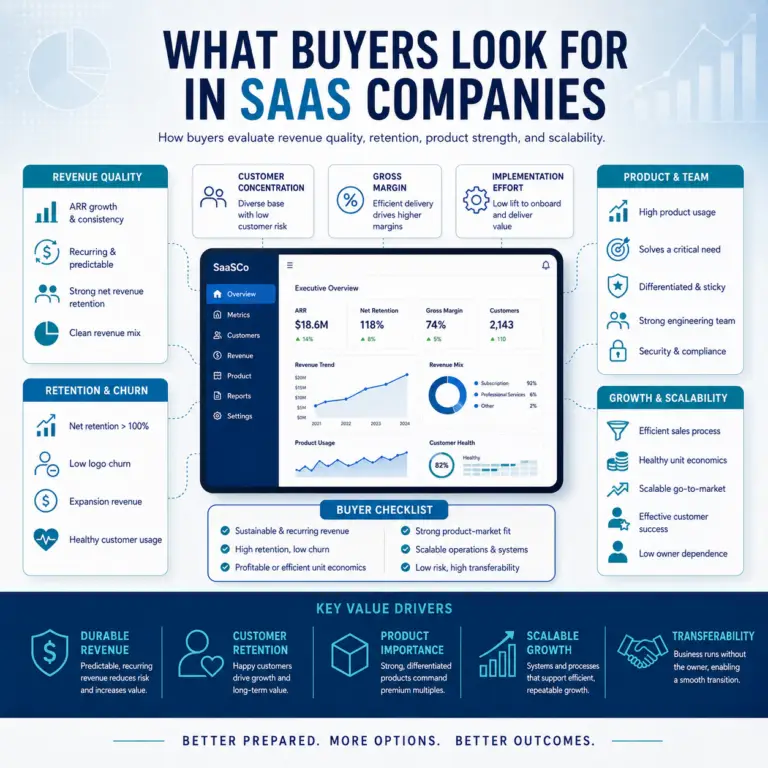
What Buyers Look for in SaaS Companies
Buyers do not only ask whether a SaaS company has revenue. They ask how durable the revenue is, why customers stay, whether the product matters, and whether the company can continue growing after a transaction.
A strong SaaS buyer story connects metrics to business quality. ARR, churn, retention, gross margin, customer concentration, implementation effort, and owner dependence are not isolated data points. Together, they tell buyers whether the revenue stream is trustworthy.
Plain-English definition
When buyers evaluate a SaaS company, they are trying to understand what they would own after closing: the customer base, product, team, revenue stream, roadmap, and growth engine. They want to know whether the company is a durable software business or a founder-led product with limited process.
Why this matters in a sale
The same revenue number can produce very different buyer reactions. A $5 million ARR company with low churn, strong margins, and a capable team is not the same as a $5 million revenue company with weak renewal data, high services mix, and a founder who owns every customer relationship.
The buyer checklist
- ARR quality: what is truly recurring and what is not.
- Gross revenue retention and net revenue retention.
- Logo churn, revenue churn, and reasons customers leave.
- Customer concentration and dependence on a few accounts.
- Gross margin and support cost by customer segment.
- Implementation effort and time to customer value.
- Product usage, adoption, and customer engagement.
- Security, compliance, and enterprise-readiness requirements.
- Engineering team depth, technical debt, and roadmap discipline.
- Sales process, pipeline quality, win rates, and source of new logos.
- Customer success process and expansion revenue.
- Owner dependence in sales, product, support, and customer relationships.
How buyers think about risk
Buyers convert uncertainty into lower valuation, more structure, or more diligence. If churn is unclear, buyers assume more risk. If revenue segmentation is unclear, buyers will classify revenue conservatively. If the product roadmap depends on one founder, buyers may require a longer transition or reduce cash at close.
Example
A vertical SaaS company has $3.5 million of ARR and 90% gross revenue retention. The product supports a specialized compliance workflow, and customers use it every week. The founder is still important, but a product lead and customer success manager handle day-to-day issues. That business gives buyers more confidence than a similar-sized company where customers rarely log in, contracts are month-to-month, and the founder handles all renewals.
Common seller mistake
The common mistake is showing buyers revenue and a product demo, but not the operating evidence behind the business. Buyers need to understand retention, margins, customer behavior, team depth, and how the company grows. A good product is not enough if the business around it is hard to underwrite.
What to prepare
- ARR, MRR, bookings, and revenue recognition details.
- Cohort retention and churn analysis.
- Customer-level revenue and contract history.
- Customer concentration by revenue and gross margin.
- Implementation timeline, onboarding process, and services margin.
- Support tickets, response times, and customer success metrics.
- Product roadmap and engineering organization chart.
- Security posture, SOC 2 readiness, data privacy, and compliance obligations.
- Sales pipeline, lead source, win rates, and sales cycle length.
- Owner role and transition plan.
Related Articles
- Software & SaaS M&A Advisor
- SaaS Valuation: ARR vs EBITDA
- Preparing a SaaS Company for Sale
- Vertical Software M&A Advisor
- Selling a Founder-Led Software Company
- Customer Concentration and Business Valuation
- Owner Dependence and Business Value
- Strategic Buyers for Software Companies
Next Steps
If you are preparing to sell a SaaS company, start by organizing the evidence buyers will ask for anyway. A clear buyer story can protect valuation and keep diligence from becoming defensive.
FAQ
Will every buyer care about the same SaaS metrics?
No. Strategic buyers, PE-backed platforms, family offices, and search funds may weigh the same facts differently. But most serious buyers will care about revenue quality, retention, margins, customer concentration, and owner dependence.
Do I need perfect metrics before selling?
No. But you should know the metrics, understand the weak spots, and decide how to explain them before buyers start diligence.