
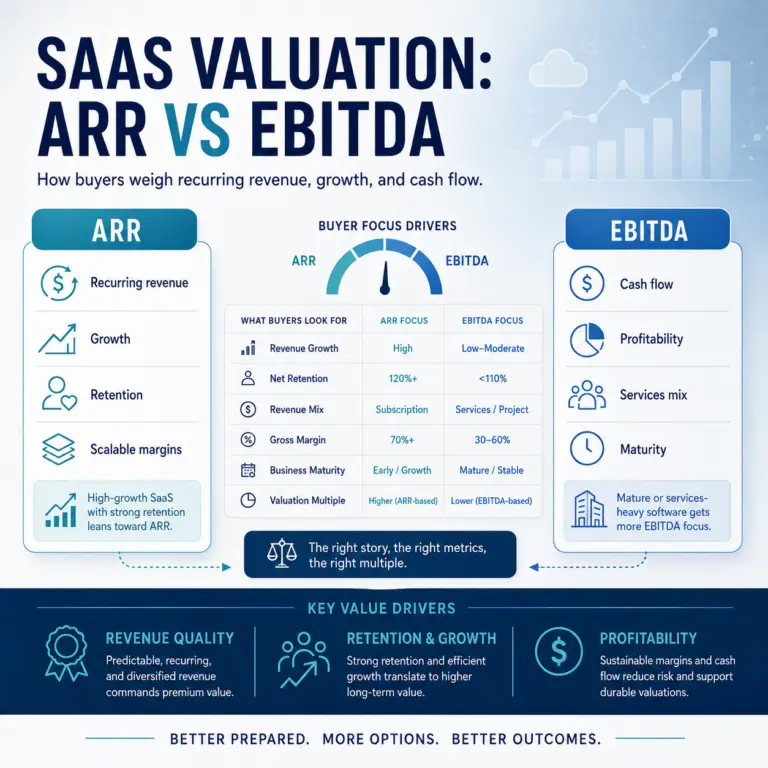
SaaS Valuation: ARR vs EBITDA
SaaS valuation is not a single multiple. Buyers may talk about ARR, revenue multiples, EBITDA multiples, retention, growth, gross margin, and Rule of 40, but the final valuation depends on how those pieces fit together.
The most common seller question is whether buyers will value the company on ARR or EBITDA. The honest answer is: it depends on size, growth, retention, profitability, revenue quality, and buyer type.
Plain-English definition
ARR stands for annual recurring revenue. It is the annualized value of subscription or recurring software revenue. ARR should not include one-time implementation fees, custom development, pass-through costs, hardware, unusual projects, or nonrecurring services.
EBITDA stands for earnings before interest, taxes, depreciation, and amortization. In lower-middle-market M&A, buyers usually focus on adjusted EBITDA, which attempts to normalize the company’s operating profit after reasonable adjustments.
When ARR matters most
ARR matters most when the company has true recurring revenue, low churn, strong growth, high gross margin, and a product that can scale without adding services labor at the same rate as revenue. ARR-based valuation is more likely when buyers believe the company can keep growing and that the recurring revenue is durable.
A buyer will not simply accept the seller’s ARR number. They will test what is included, which customers are active, whether contracts renew, whether revenue is at risk, and whether services revenue has been incorrectly included.
When EBITDA matters more
EBITDA matters more when growth is modest, the company is mature, services are a meaningful part of revenue, churn is higher, or the business requires substantial labor to support each customer. A profitable software company can still be valuable, but buyers will not pay a premium SaaS revenue multiple if the company behaves more like a services firm.
How buyers think about ARR vs EBITDA
Buyers usually do not choose one metric and ignore the other. They use ARR to understand revenue quality and scale, and EBITDA to understand cash flow and efficiency. A high-growth software company with low EBITDA may still receive serious buyer interest if retention and gross margin are strong. A slower-growth company with strong EBITDA may be valued more like a profitable software business than a growth SaaS asset.
Company Profile | Primary Buyer Lens | Likely Buyer Questions |
High-growth SaaS with strong retention | ARR or revenue multiple | Is growth durable? Is churn low? Are margins scalable? |
Mature profitable SaaS | ARR and adjusted EBITDA | How much recurring revenue is real? What is normalized profit? |
Software plus services | EBITDA with revenue quality analysis | Is this software-led or services-led? What revenue repeats? |
Legacy license and maintenance | EBITDA and retention | Will maintenance renew? What investment is needed? |
Low-growth or high-churn SaaS | EBITDA and risk discount | Why are customers leaving? What growth remains? |
Example
Two SaaS companies each report $4 million of ARR. Company A is growing 25%, has 95% gross revenue retention, 115% net revenue retention, 80% gross margins, and modest customer concentration. Company B is flat, has weak renewal data, 70% gross retention, heavy services revenue, and the founder owns product and sales. Buyers will not value those two businesses the same way, even if the ARR number is identical.
Common seller mistake
The common mistake is asking for an ARR multiple without proving ARR quality. Buyers care about what is recurring, profitable, retained, and scalable. Another mistake is using public SaaS multiples or venture financing language for a smaller founder-led company with different size, liquidity, risk, and growth characteristics.
What to prepare
- ARR schedule with clear inclusion and exclusion rules.
- MRR or ARR bridge showing new, expansion, contraction, churn, and price increases.
- Gross revenue retention and net revenue retention by cohort.
- Logo churn and revenue churn for at least three years if available.
- Revenue by customer, product, service line, and month.
- Gross margin by revenue type: subscription, services, support, implementation, and other.
- Adjusted EBITDA bridge with support for add-backs.
- Customer concentration and contract renewal schedule.
- Pipeline, bookings, win rates, and sales cycle data.
Related Articles
- Software & SaaS M&A Advisor
- What Buyers Look for in SaaS Companies
- Preparing a SaaS Company for Sale
- Vertical Software M&A Advisor
- Software Plus Services Businesses
- EBITDA vs SDE in Lower Middle Market M&A
- How Buyers Value Recurring Revenue Service Businesses
- Customer Concentration and Business Valuation
- Owner Dependence and Business Value
Next Steps
If you are unsure whether your software company should be positioned around ARR, EBITDA, or both, clarify the revenue and earnings story before speaking with buyers. That prevents confusion and avoids letting buyers define the valuation framework for you.
FAQ
Is ARR always better than EBITDA for SaaS valuation?
No. ARR matters when revenue is truly recurring and durable. EBITDA matters when buyers care more about cash flow, maturity, services mix, or risk.
Can a profitable SaaS company still get a revenue multiple?
Yes, but buyers will still evaluate retention, growth, gross margin, customer concentration, and management depth. Profitability helps, but it does not replace revenue quality.