
EBITDA vs SDE in Lower Middle Market M&A
EBITDA and SDE are both ways to measure earnings, but they are not the same number, and they are not used in the same situations. Confusing the two can lead to unrealistic valuation expectations and difficult conversations with buyers.
Plain-English definition
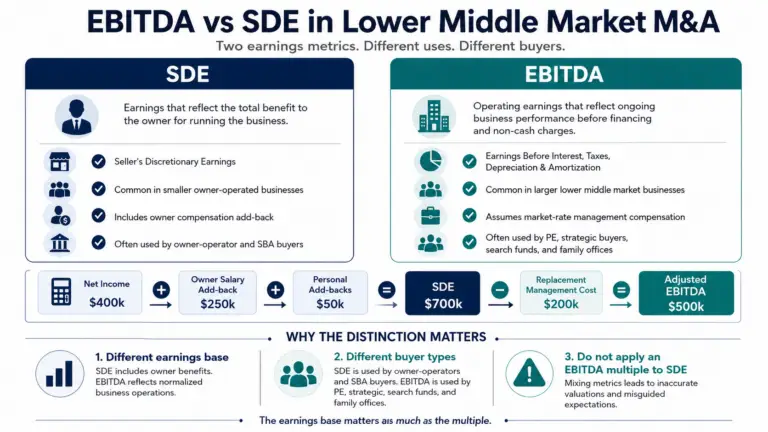
SDE stands for Seller’s Discretionary Earnings. It is usually used for smaller owner-operated businesses. SDE estimates the total economic benefit available to a single full-time owner-operator before the owner pays themselves, plus certain add-backs such as personal or discretionary expenses, interest, taxes, depreciation, and amortization.
EBITDA stands for Earnings Before Interest, Taxes, Depreciation, and Amortization. In lower-middle-market M&A, adjusted EBITDA usually refers to company-level operating earnings after normalizing expenses and accounting for a market-rate management team. EBITDA is meant to show what the business earns as a company, not what one owner-operator can take out of it.
When it matters
SDE is most common when the buyer is likely to be an owner-operator or SBA buyer who will step into the seller’s role. In that situation, the buyer wants to understand the total cash flow available to one working owner.
EBITDA is more common when the business is large enough to require management beyond the owner, or when the buyer is a private equity group, a strategic buyer, a family office, or a search fund. These buyers usually need to know what the company earns after paying people to perform the roles the owner currently handles.
There is no perfect line, but many smaller businesses with earnings of roughly $1 million or less are discussed in SDE terms, while larger businesses with $1 million to $2 million or more in true management-adjusted earnings are more likely to be discussed in EBITDA terms. The real issue is not only size. It is whether the business has management depth.
How buyers think about it
Buyers do not want sellers to use an SDE earnings base and an EBITDA multiple at the same time. That double counts value. SDE is usually a higher earnings number because it adds back owner compensation. EBITDA is usually a lower earnings number because it assumes the business must pay someone to perform management duties.
A lower multiple on SDE can produce a valuation similar to that of a higher multiple on EBITDA. The multiple alone does not tell the story. The earnings base matters.
Example
Item | Amount |
Net income | $400,000 |
Owner salary added back | $250,000 |
Personal/discretionary add-backs | $50,000 |
Estimated SDE | $700,000 |
Less market-rate general manager/CEO compensation | ($200,000) |
Estimated adjusted EBITDA | $500,000 |
A buyer might value this business at 3.0x SDE, or $2.1 million. Another buyer might value it at 5.0x adjusted EBITDA, or $2.5 million. The EBITDA multiple is higher, but it is applied to a lower earnings base. A seller cannot reasonably claim the company has $700,000 of SDE and should receive a 5.0x EBITDA multiple on that amount.
Common seller mistake
The most common mistake is calling SDE “EBITDA.” If the seller adds back the owner’s full salary but does not include a replacement management cost, the number is usually closer to SDE than EBITDA.
Another mistake is assuming that a buyer will ignore the cost of replacing the owner. If the owner runs sales, operations, finance, and customer relationships, a buyer has to account for that work. Either the buyer performs it personally, hires someone to do it, or structures the deal to keep the seller involved.
What to prepare
- Profit and loss statements for at least three years and trailing twelve months.
- Owner compensation and benefits.
- Support for personal, discretionary, or non-recurring add-backs.
- Clear description of the owner’s actual role in the business.
- Estimated market-rate compensation for any owner duties a buyer would need to replace.
- List of family members or related-party expenses in the business.
- Debt, interest, taxes, depreciation, and amortization detail.
- A bridge from net income to SDE and from SDE to adjusted EBITDA.
Related Articles
- Preparing Your Business for Sale
- Owner Dependence and Business Value
- What Buyers Look for in Founder-Led B2B Services Companies
- How Buyers Value Recurring Revenue Service Businesses
- SaaS Valuation: ARR vs EBITDA
- MSP Valuation Guide
Next Steps
If you are unsure whether your business should be presented using SDE, EBITDA, or both, it is worth clarifying before speaking with buyers. The right earnings presentation can prevent confusion and help set realistic valuation expectations.