
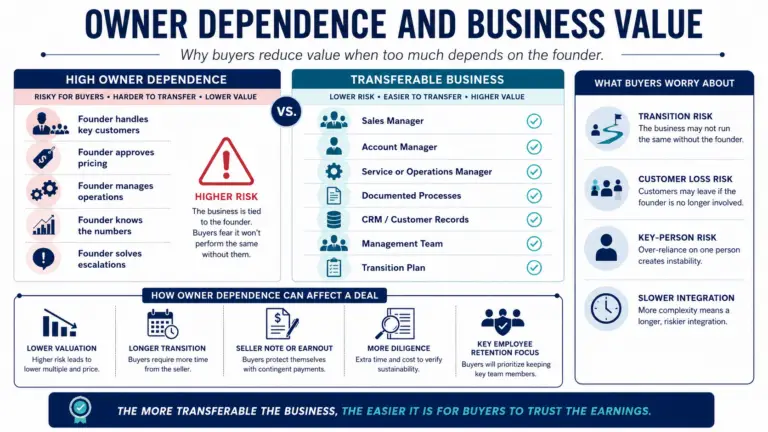
Owner Dependence and Business Value
Owner dependence is one of the most common reasons buyers reduce value in founder-led companies. The business may be profitable, but if too much of that profit depends on the owner personally, buyers will treat the earnings as riskier.
Plain-English definition
Owner dependence means the business relies heavily on the owner for sales, customer relationships, operations, pricing, technical knowledge, employee management, vendor relationships, or financial decision-making. The issue is not whether the owner works hard. The issue is whether the company can keep producing results when the owner changes roles.
A buyer does not need the owner to be irrelevant. Most buyers expect founders to matter. But they need to know which responsibilities are transferable and which responsibilities still sit only in the owner’s head.
When it matters
Owner dependence matters in almost every founder-led sale. It matters more when the buyer is a PE-backed platform, strategic acquirer, or search fund that expects the business to continue operating after closing. It also matters when the seller wants a high percentage of cash at close and a limited post-closing role.
If the seller wants to leave quickly but the business cannot operate without the seller, there is a mismatch. Buyers may still be interested, but they will protect themselves through structure, transition requirements, or a lower price.
How buyers think about it
Buyers translate owner dependence into transition risk. They ask what breaks if the owner is gone for two weeks, then what breaks if the owner is gone permanently. They look at customer relationships, employee reporting, sales process, financial controls, delivery management, and technical knowledge.
The concern is not theoretical. If the owner is the only person customers trust, employees follow, or vendors call, the buyer is not just buying a company. The buyer is buying a transition project.
Example
A $7 million revenue MSP has strong EBITDA, but the owner personally handles the top ten customers, approves all project pricing, closes most new business, and resolves escalated service issues. The service team is capable, but customers see the owner as the company. A buyer may like the earnings but worry that customer retention depends on the owner staying involved.
That same MSP would be more valuable if a service manager owned delivery, an account manager handled renewals, customer contacts were documented in the CRM, and the owner’s role could be limited to transition support.
Common seller mistake
The common mistake is saying, “The business runs without me,” when the evidence says otherwise. Buyers will test that claim. They will ask who handles sales, who manages customer issues, who knows the financials, who owns delivery, and who makes pricing decisions.
Another mistake is waiting until a sale process to delegate. Buyers trust patterns more than promises. A team that has been operating independently for twelve months is more convincing than a plan to delegate after closing.
What to prepare
- A written description of the owner’s current weekly responsibilities.
- Organization chart showing who manages sales, operations, finance, and delivery.
- Customer relationship map showing contacts beyond the owner.
- List of key employees and their responsibilities.
- Process documentation for sales, onboarding, service delivery, billing, and renewals.
- Evidence that the team can make decisions without the owner.
- Transition plan showing what the owner will do after closing and for how long.
- Retention plan for key employees.
Related Articles
- What Buyers Look for in Founder-Led B2B Services Companies
- Preparing Your Business for Sale
- Customer Concentration and Business Valuation
- EBITDA vs SDE in Lower Middle Market M&A
- Selling a Founder-Led MSP
- Selling a Founder-Led Software Company
Next Steps
If your business still depends heavily on you, that does not mean it cannot be sold. It does mean the issue should be understood and framed before buyers use it to reduce value or shift risk back to you.