
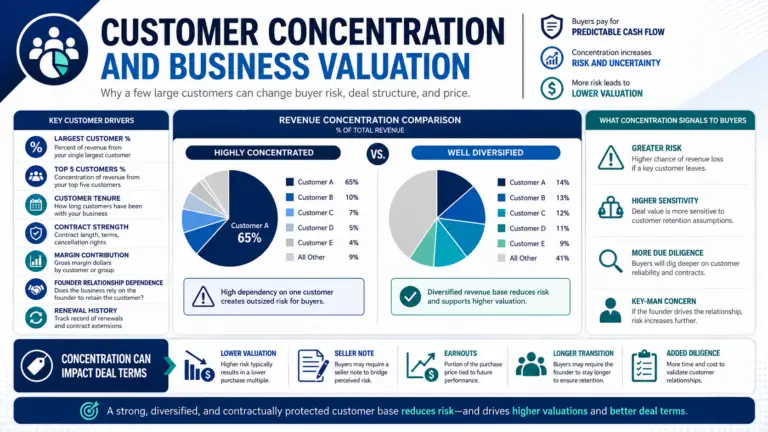
Customer Concentration and Business Valuation
Customer concentration does not automatically kill a deal, but it changes how buyers think about risk. A large customer can be a sign of strength, but if losing that customer would materially reduce EBITDA, the buyer will almost certainly adjust valuation, structure, or diligence.
Plain-English definition
Customer concentration means a meaningful percentage of revenue or profit comes from a small number of customers. Buyers usually look at the largest customer, the top five customers, the top ten customers, and sometimes concentration by industry, geography, channel, or contract type.
A company with one customer representing 35% of revenue has a different risk profile from a company in which the largest customer accounts for 6% of revenue. Concentration matters even more when the large customer is also high-margin or personally tied to the founder.
When it matters
Customer concentration matters whenever a buyer or lender asks what would happen if a major customer left. It matters in valuation, financing, indemnity, seller notes, earnouts, working capital, and post-closing transition planning.
Concentration can be acceptable if the customer relationship is long-tenured, contracted, diversified across locations or departments, and not dependent on the owner. It becomes more concerning when the contract is short-term, the relationship is personal, pricing is unusual, or the customer has recently reduced spending.
How buyers think about it
Buyers do not only look at the percentage. They ask how durable the customer relationship is and how painful a loss would be. A 20% customer with a ten-year history, multiple contacts, strong margin, and a multi-year contract is different from a 20% customer with no contract and a relationship owned by the founder.
Buyers may respond to concentration in several ways: reduce the price, defer part of the price, require customer calls before closing, ask for a seller note, require a longer transition, or structure an earnout tied to retention.
Example
A business has $1 million of EBITDA. Its largest customer represents 30% of revenue and 40% of EBITDA because the account is unusually profitable. If that customer leaves, EBITDA may fall from $1 million to $600,000. A buyer will not ignore that risk. Even if the headline purchase price remains attractive, the buyer may try to shift part of the price into a seller note or retention-based earnout.
Common seller mistake
The common mistake is saying, “They have been with us for years, so they are not going anywhere.” That may be true, but buyers need evidence. They will want contract history, renewal behavior, relationship depth, usage, margins, and whether the customer has a practical reason to stay after the sale.
Another mistake is calculating concentration based solely on revenue. A customer that represents 15% of revenue but 30% of profit may be more important than the revenue percentage suggests.
What to prepare
- Revenue by customer for at least three years.
- Gross margin or EBITDA contribution by major customer if available.
- Top 5 and top 10 customer concentration.
- Customer tenure and renewal history.
- Contracts, renewal dates, termination rights, and assignment language.
- List of relationship contacts beyond the founder.
- Explanation of why each major customer stays.
- Any recent pricing changes, service issues, or renewal concerns.
- Plan for buyer/customer introductions after LOI or near closing.
Related Articles
- What Buyers Look for in Founder-Led B2B Services Companies
- Preparing Your Business for Sale
- Owner Dependence and Business Value
- EBITDA vs SDE in Lower Middle Market M&A
- MSP Customer Concentration
- Strategic Buyers vs Private Equity Buyers
Next Steps
If a few customers account for a large share of your business, the issue should be identified before buyers raise it. Concentration can often be explained, but it should not be discovered late in diligence.