
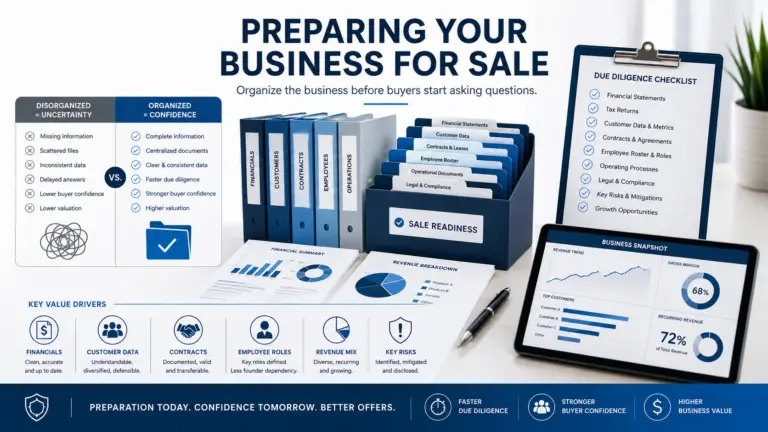
Preparing Your Business for Sale
Preparing a business for sale is not about dressing it up. It is about making the business easier for a serious buyer to understand, trust, finance, and close. The best preparation reduces uncertainty before buyers use that uncertainty to reduce price or change terms.
Plain-English definition
Preparing your business for sale means organizing the financial, operational, customer, employee, and legal information a buyer will need to evaluate the company. It also means identifying the issues that could slow diligence, create mistrust, or give a buyer leverage late in the process.
Preparation does not mean fixing every weakness. It means knowing what buyers will care about and deciding what should be cleaned up before the company is introduced to the market.
When it matters
Preparation matters most before a seller signs an LOI. Once a buyer has exclusivity, the seller has less leverage. If a problem arises after the LOI, the buyer may request a price reduction, a seller note, an earnout, a working capital adjustment, or a longer transition period.
Preparation is especially important for founder-led companies because buyers often expect messy financials, undocumented processes, customer concentration, and owner dependence. A prepared seller can separate normal small-business messiness from real deal risk.
How buyers think about it
Buyers use preparation as a proxy for business quality. Clean information does not guarantee a premium valuation, but disorganized information creates doubt. If a seller cannot explain revenue, margins, customer retention, or employee roles, buyers start wondering what else is unclear.
A well-prepared company makes the buyer’s job easier. That matters because buyers compare opportunities. A business that is easier to underwrite often keeps buyer attention longer and has a better chance of preserving price and terms.
Example
Two companies each generate $10 million in revenue and $1.5 million of EBITDA. One seller can provide monthly financials, customer-level revenue, contracts, employee roles, revenue by service line, and a clear explanation of owner involvement. The other seller has tax returns, scattered spreadsheets, unclear add-backs, and no customer revenue history.
The second company may still be a good business, but the process will be harder. Buyers will spend more time reconstructing the story and less time building confidence. That usually affects speed, leverage, and sometimes price.
Common seller mistake
The biggest mistake is waiting until a buyer asks for information. By then, the seller is reacting. The better approach is to anticipate buyer diligence and prepare the core materials before the process starts.
Another mistake is hiding weaknesses. Serious buyers usually find them. It is better to understand the issue, explain it clearly, and show whether it has been addressed.
What to prepare
- Monthly profit and loss statements and balance sheets for the last three years and trailing twelve months.
- Revenue by customer and service line.
- Recurring, repeat, project, resale, and one-time revenue breakdown.
- Top customer concentration and customer tenure.
- Contracts, renewal dates, and assignment/change-of-control language.
- Employee roster with roles, tenure, compensation, and key-person risk.
- Owner add-backs and normalized EBITDA or SDE support.
- Sales pipeline, backlog, and source of new revenue.
- Operating processes, key systems, and vendor dependencies.
- Known risks and how they should be framed.
Related Articles
- What Buyers Look for in Founder-Led B2B Services Companies
- EBITDA vs SDE in Lower Middle Market M&A
- Customer Concentration and Business Valuation
- Owner Dependence and Business Value
- Strategic Buyers vs Private Equity Buyers
- Why One Buyer Is No Buyer
Next Steps
If you are thinking about selling within the next year or two, the best time to prepare is before buyers are involved. A short review of your financials, customer base, and owner dependence can identify the issues that matter most.