
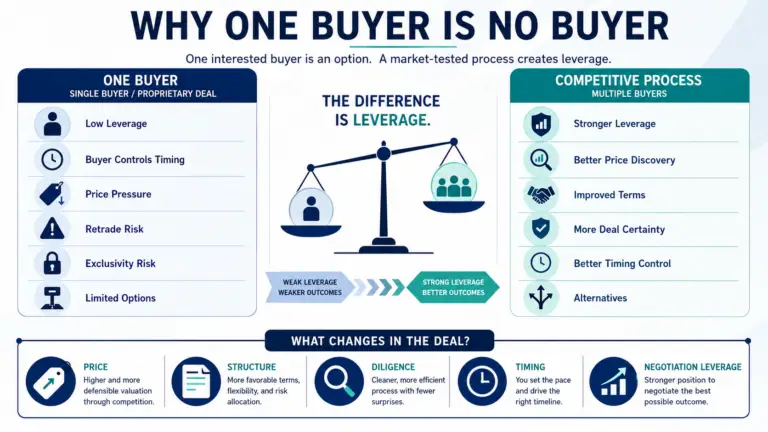
Why One Buyer Is No Buyer
One interested buyer can feel like a sales process. It is not. One buyer is an option. A market-tested process is leverage. Until a seller has alternatives, the buyer has too much control over price, timing, diligence, and deal structure.
Plain-English definition
“One buyer is no buyer” means a seller should not confuse interest from a single buyer with market value. A buyer may be serious, but without competition, the seller does not know whether the offer is strong, weak, fair, or simply convenient for the buyer.
This does not mean every sale needs a broad auction. It means a seller should understand the likely buyer universe before allowing one party to control the process.
When it matters
This matters when a buyer approaches a seller directly, when a competitor says it wants to acquire the company, or when a private equity-backed platform asks for a proprietary conversation. These buyers may be credible, but they are also trying to avoid competition.
It also matters after an LOI. Once a seller grants exclusivity, the buyer has more leverage. If diligence creates a disagreement, the seller may have no other active buyer to return to.
How buyers think about it
Buyers like proprietary deals because they reduce competition. Less competition can mean lower prices, more buyer-friendly terms, more time for due diligence, and more room to retrade if issues arise. That is not immoral. It is rational buyer behavior.
Sellers need to behave just as rationally. If the business is attractive, there may be multiple buyer types: strategic buyers, PE-backed platforms, private equity firms, family offices, search funds, and industry operators. A good process tests what buyers care about.
Example
A PE-backed MSP platform approaches a $5 million revenue MSP and offers what sounds like a fair multiple. The buyer asks for exclusivity before the seller talks to anyone else. If the seller agrees, the buyer controls the next phase. If diligence later raises concerns about customer concentration or owner dependence, the buyer can reduce the price or add a seller note. The seller may feel trapped because no other buyers are active.
If the seller had quietly tested a focused buyer universe first, the same buyer might still win. But the seller would have context, alternatives, and more leverage in negotiating price and terms.
Common seller mistake
The common mistake is overvaluing convenience. A direct buyer feels easy because there is no marketing process, no buyer list, and no competitive outreach. But easy at the beginning can become expensive later if the buyer controls the process.
Another mistake is thinking only about the headline price. A single buyer may offer a good headline number but shift risk through seller financing, earnouts, working capital terms, indemnities, employment agreements, or delayed closing conditions.
What to prepare
- A realistic buyer universe before signing exclusivity.
- Clear valuation expectations based on business quality, not just buyer comments.
- A summary of strengths and risks buyers are likely to see.
- A confidentiality plan for competitors and sensitive buyers.
- A decision framework for comparing price, cash at close, structure, transition, and certainty.
- A plan for handling unsolicited buyer outreach.
- An understanding of which deal terms matter besides purchase price.
Related Articles
- Strategic Buyers vs Private Equity Buyers
- Preparing Your Business for Sale
- Customer Concentration and Business Valuation
- Owner Dependence and Business Value
- What Buyers Look for in Founder-Led B2B Services Companies
- PE-Backed MSP Buyers
Next Steps
If a buyer has approached you directly, it may be worth taking the conversation seriously. But before granting one buyer exclusivity, assess whether other buyers may value the company differently or offer better terms.