
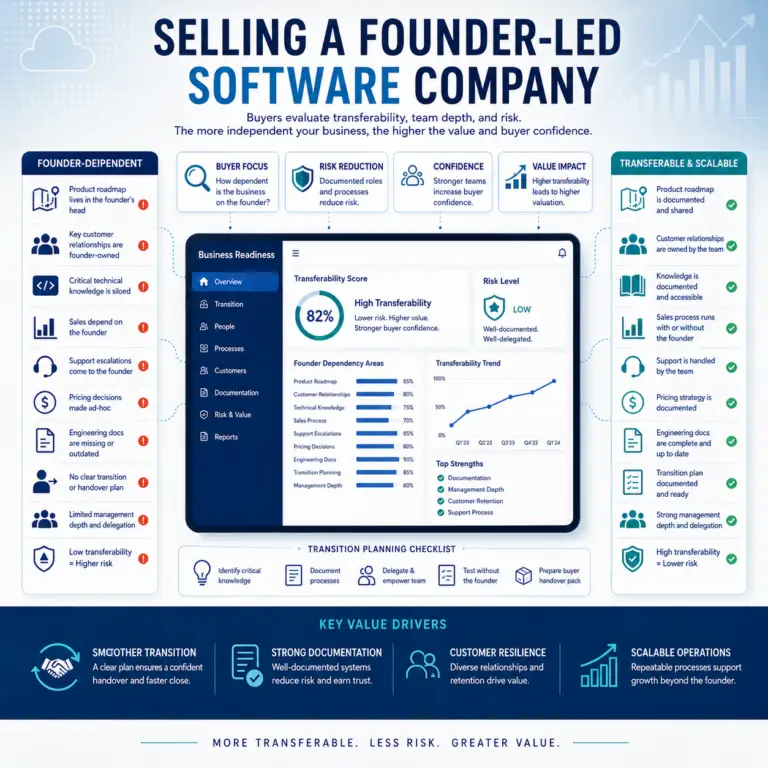
Selling a Founder-Led Software Company
Founder-led software companies can be attractive acquisition targets, but buyers need confidence that the business will continue after the founder steps back. A profitable company with high owner dependence can still sell, but the buyer will usually protect itself through valuation, structure, transition expectations, or diligence conditions.
Plain-English definition
A founder-led software company is a business in which the founder still plays a central role in sales, product direction, customer relationships, technical decisions, pricing, key hires, support escalations, and financial reporting. That is normal in smaller companies. The issue is whether the founder’s role is transferable.
When it matters
Owner dependence matters most when the seller wants significant cash at closing and a limited post-closing role. If customers, engineers, product decisions, and sales all depend on the founder personally, buyers may worry that the company’s value is tied too closely to one person.
Where founder dependence shows up in software
- The founder owns the product roadmap and all major product tradeoffs.
- The founder is the only person who can explain the codebase or architecture.
- The founder handles the largest customer relationships and renewals.
- The founder closes most new deals.
- Support escalations go directly to the founder.
- Pricing, discounting, and contract exceptions require founder approval.
- No one else can explain ARR, churn, gross margin, or implementation effort.
- The engineering team is contractor-heavy and undocumented.
How buyers think about it
Buyers translate founder dependence into transition risk. If the founder is essential to product, sales, engineering, and customer retention, the buyer has to account for the cost and risk of replacing that role. That can lead to a lower valuation, a seller note, an earnout, a longer employment agreement, or a requirement that key employees stay after closing.
Example
A $6 million ARR vertical SaaS company has strong retention, but the founder still leads product, owns the top ten customer relationships, and is the only person who understands the original architecture. Buyers may like the market and customer base, but they will worry about what happens after closing. The same company would be more transferable if a product manager owned roadmap execution, customer success handled renewals, engineering documentation existed, and major customers had relationships beyond the founder.
How to reduce the concern
- Document the founder’s actual weekly responsibilities.
- Move routine renewals and customer success away from the founder before going to market.
- Create product roadmap documentation and technical architecture notes.
- Make sure the CRM shows customer contacts, history, renewal dates, and open issues.
- Identify technical leads who can speak credibly with buyers.
- Prepare a realistic transition plan rather than promising to leave immediately.
- Create retention plans for key engineering, product, and customer success employees.
Common seller mistake
The common mistake is saying, “The company runs without me,” when the evidence says otherwise. Buyers will test that claim. They will ask who sells, who renews customers, who owns the roadmap, who understands the code, and who can make decisions without the founder. Buyers trust patterns more than promises.
What to prepare
- Written description of the founder’s current role.
- Organization chart showing sales, product, engineering, support, customer success, and finance ownership.
- Customer relationship map showing contacts beyond the founder.
- Product roadmap and technical documentation.
- Key employee list with roles, tenure, compensation, and retention risk.
- Support escalation and customer success processes.
- Transition plan showing what the founder will do after closing and for how long.
Related Articles
- Software & SaaS M&A Advisor
- What Buyers Look for in SaaS Companies
- Preparing a SaaS Company for Sale
- SaaS Valuation: ARR vs EBITDA
- Owner Dependence and Business Value
- Customer Concentration and Business Valuation
- Strategic Buyers for Software Companies
Next Steps
If your software company still depends heavily on you, that does not mean it cannot be sold. It does mean the issue should be understood and framed before buyers use it to reduce value or shift risk back to you.
FAQ
Do buyers expect the founder to stay after closing?
Usually, yes. Most buyers want a thoughtful transition. The concern is not whether the founder matters. The concern is whether the company can eventually operate without the founder doing everything.
Can founder dependence be fixed quickly?
Some documentation and role clarity can be improved quickly. True transferability usually requires patterns that exist before the sale process starts.