
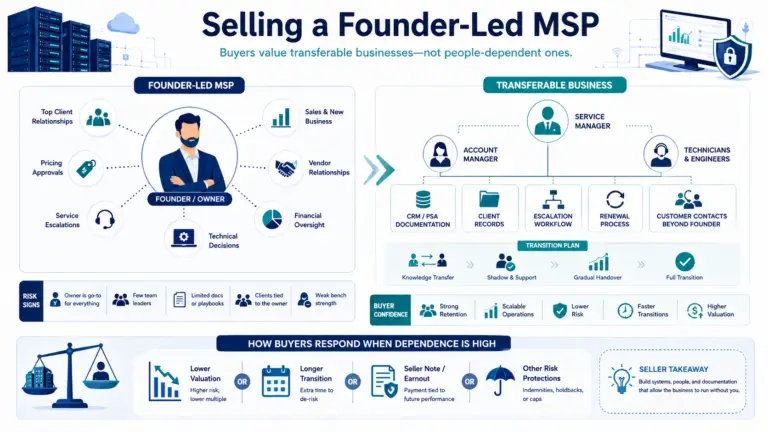
Selling a Founder-Led MSP
Founder-led MSPs can be very attractive acquisition targets, but buyers need confidence that the business will continue after the owner steps back. A profitable MSP with high owner dependence can still sell, but the buyer will usually protect itself through valuation, structure, transition expectations, or diligence conditions.
Plain-English definition
A founder-led MSP is a managed IT services business in which the owner continues to play a central role in sales, customer relationships, service escalations, pricing, technical decisions, employee management, vendor relationships, and financial reporting. That is normal in smaller companies. The issue is whether the owner’s role is transferable.
When it matters
Owner dependence matters most when the seller wants meaningful cash at closing and a limited post-closing role. If customers, employees, and vendors all rely on the owner personally, a buyer may worry that the company’s value is tied too closely to one person.
Where owner dependence shows up in an MSP
- The founder owns the top client relationships.
- The founder approves pricing, discounts, and contract exceptions.
- The founder resolves most escalated service issues.
- Technicians rely on the founder for technical or operational decisions.
- The founder is the only person who understands margins, contracts, or vendor economics.
- New business depends almost entirely on the founder’s relationships.
- Customers see the founder as the company.
How buyers think about it
Buyers translate founder dependence into transition risk. If the owner is essential to client retention, service quality, sales, or employee stability, the buyer must account for that risk. The buyer may ask for a longer transition, a seller note, an earnout, customer retention conditions, or a lower cash-at-close offer.
Example
A $7 million MSP has strong EBITDA, but the founder personally handles the top ten clients, approves project pricing, and resolves major escalations. The service team is capable, but clients still call the founder when something important is at stake. A buyer may like the business but worry that client retention depends on the founder’s continued involvement. The same MSP would be more transferable if a service manager owned delivery, an account manager handled renewals, client contacts were documented in the CRM, and the founder’s role could be limited to transition support.
How to reduce the concern
- Document who owns each client relationship beyond the founder.
- Move renewals and routine account management to a manager or account lead before going to market.
- Create written escalation, onboarding, pricing, and renewal processes.
- Make sure PSA/CRM records show contacts, agreements, issues, and renewal history.
- Identify a service manager or operations lead who can speak credibly with buyers.
- Prepare a realistic transition plan rather than promising to leave immediately.
Common seller mistake
The common mistake is saying, “The business runs without me,” when the evidence says otherwise. Buyers will test that claim. They will ask who sells, who manages client issues, who knows the financials, who owns delivery, and who makes pricing decisions. Buyers trust patterns more than promises.
What to prepare
- Written description of the owner’s current weekly responsibilities.
- Organization chart showing ownership of sales, operations, finance, and delivery.
- Client relationship map showing contacts beyond the owner.
- List of key employees, tenure, roles, compensation, and retention risk.
- Documented processes for onboarding, renewals, service delivery, escalation, billing, and pricing.
- Evidence that the team can make decisions without the owner.
- Transition plan showing what the owner will do after closing and for how long.
Related Articles
- MSP & Managed IT Services M&A Advisor
- MSP Valuation Guide
- What Buyers Look for in an MSP
- Preparing an MSP for Sale
- MSP Customer Concentration
- PE-Backed MSP Buyers
- Owner Dependence and Business Value
- Preparing Your Business for Sale
Next Steps
If your MSP still depends heavily on you, that does not mean it cannot be sold. It does mean the issue should be understood and framed before buyers use it to reduce value or shift risk back to you.