
What Buyers Look for in an MSP
Buyers do not only ask whether an MSP is profitable. They ask how durable the revenue is, how dependent the business is on the owner, whether the service model can scale, and what would happen after closing if the founder stepped back.
Plain-English definition
When buyers evaluate an MSP, they are deciding whether the business is a transferable managed services company or a local IT shop built around one owner. They want evidence that clients will stay, employees can deliver, margins are sustainable, and the company can grow without heroic founder involvement.
Why this matters in a sale
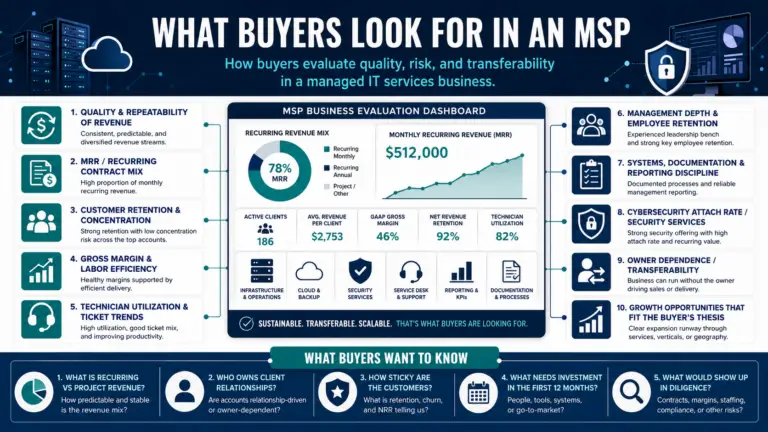
In MSP and managed IT, buyers look closely at MRR, recurring contract mix, gross margin, technician utilization, ticket trends, client retention, cybersecurity attach rate, customer concentration, and owner dependence. If the information is organized before the process starts, the seller has a better chance of controlling the narrative. If the buyer has to reconstruct the story during diligence, the process usually becomes slower and more defensive.
The buyer checklist
- Quality and repeatability of revenue. Buyers want to know what is contracted MRR, what is repeat work, and what must be replaced each year.
- Client retention and concentration: Buyers want sticky clients, but they also want to know whether one or two accounts could materially reduce EBITDA if lost.
- Gross margin and labor efficiency. Healthy recurring revenue is less valuable if service delivery requires too much technician time or constant escalation.
- Technician utilization and service desk discipline: Ticket volume, response time, resolution time, SLA performance, backlog, and escalation patterns help buyers assess operational quality.
- Management depth and employee retention. A service manager, account manager, or operations lead reduces transition risk.
- Systems, documentation, and reporting. Buyers like PSA/RMM discipline, standardized agreements, documented onboarding, and clear reporting.
- Cybersecurity attach rate. Security, backup, compliance, and risk management can make the MSP more strategic if they are recurring and profitable.
- Growth opportunities: Buyers want credible expansion paths: pricing, cross-sell, cybersecurity, cloud, geography, vertical specialization, or add-on acquisitions.
How buyers think about risk
A buyer is not only asking whether the MSP has good clients. The buyer is asking whether those clients are attached to the company or to the owner. They are not only asking whether the service team is busy. They are asking whether the delivery model is profitable and repeatable. They are not only asking whether the MSP offers cybersecurity. They are asking whether security revenue is attached, priced correctly, and delivered with a real process.
Example
A $5 million revenue MSP may look attractive because it has strong EBITDA. But if the founder personally handles pricing, renewals, escalations, and top clients, the buyer will see transition risk. If the same MSP has a service manager, account ownership outside the founder, clean MRR reporting, and documented ticket metrics, buyers can underwrite the business with more confidence.
Common seller mistake
The common mistake is assuming buyers will accept broad statements like “our clients are sticky” or “most of our revenue is recurring.” Buyers want proof. They will ask for customer-level revenue, contract terms, churn history, PSA reports, gross margin, ticket data, and evidence that the business is not dependent on the owner.
Questions a seller should be ready to answer
- How much revenue is recurring, repeat, project, resale, or one-time?
- What is the current MRR, and how has it changed over the last 24-36 months?
- What are the top customer concentrations, and how long have those clients been with the company?
- What are client retention, churn, and price increase history?
- Who owns sales, delivery, finance, and customer relationships besides the owner?
- What are the core PSA/RMM tools, and how clean is the reporting?
- What would a buyer need to invest in during the first 12 months?
- What would show up in diligence that should be explained upfront?
Related Articles
- MSP & Managed IT Services M&A Advisor
- MSP Valuation Guide
- Preparing an MSP for Sale
- Cybersecurity Revenue in MSP Valuation
- MSP Customer Concentration
- Selling a Founder-Led MSP
- What Buyers Look for in Founder-Led B2B Services Companies
- Preparing Your Business for Sale
- Owner Dependence and Business Value
Next Steps
If you are thinking about selling, the first step is not a valuation guess. It is about understanding how buyers would view the business, what would create interest, and what should be cleaned up before a confidential process begins.
FAQ
Will every buyer care about the same issues? No. Strategic buyers, PE-backed platforms, family offices, search funds, and local operators often weigh the same facts differently. A good process identifies which buyer type has the strongest reason to care.
Do I need to fix every issue before going to market? No. But you should know the issues and decide which ones are worth addressing before buyers start due diligence.