
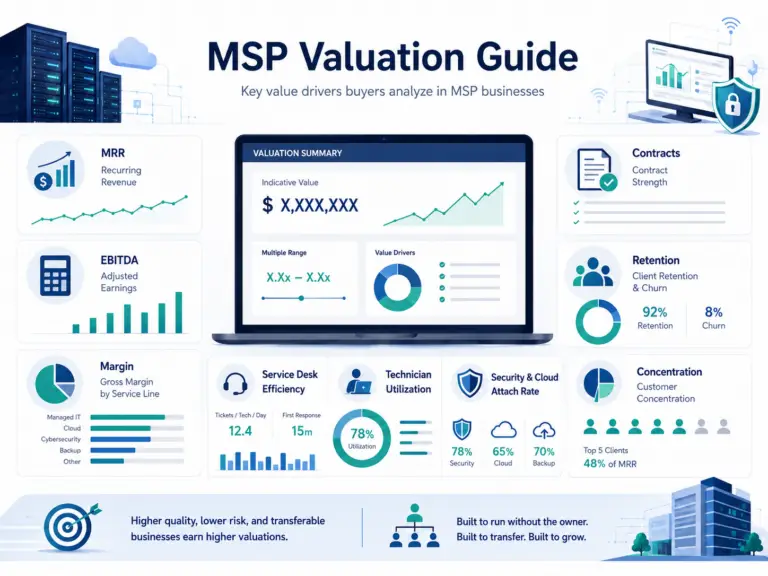
MSP Valuation Guide
MSP valuation is not simply a multiple pulled from the market. Buyers start with earnings, then adjust for revenue quality, contract strength, client retention, margin, owner dependence, and post-closing investment needs. Two MSPs with the same EBITDA can receive very different offers if one has clean recurring revenue and the other depends on projects and founder relationships.
Plain-English definition
An MSP valuation estimates what a buyer is willing to pay for the future cash flow of a managed IT services company. The buyer is not just buying last year’s profit. The buyer is buying the expectation that clients, employees, systems, and margins will continue after closing.
In smaller owner-operated MSPs, buyers may look at SDE or owner benefit. In lower middle market MSPs with management depth, buyers usually focus on adjusted EBITDA and recurring revenue quality. The multiple is only meaningful after the earnings base is clearly defined.
When valuation becomes more favorable
MSP valuation tends to improve when revenue is recurring, contracts are clear, churn is low, gross margin is healthy, service delivery is documented, and the owner is not the only person holding the company together. Buyers also like cybersecurity, backup, compliance, and cloud services when those offerings increase retention and wallet share.
A rough way to think about valuation
Actual offers depend on market conditions, size, growth, buyer fit, and risk. Still, sellers should understand the broad logic buyers use:
- Small owner-operated IT support firms with limited recurring revenue often trade more like local service businesses.
- MSPs with meaningful MRR, clean contracts, and $500k-$1m+ of earnings usually receive more buyer attention.
- Larger MSPs with $1m-$3m+ of adjusted EBITDA, strong retention, mature systems, and management depth can attract strategic and PE-backed platform interest.
- True platform-quality MSPs with scale, leadership, high recurring revenue, strong margins, and a clear growth engine can command stronger valuation and better terms.
The more important point: a high multiple is usually earned by reducing buyer risk. Sellers do not get a premium simply because the company is called an MSP.
How buyers build the valuation case
- They normalize EBITDA or SDE and test the add-backs.
- They separate recurring managed services from projects, resale, one-time work, and pass-through revenue.
- They examine customer retention, churn, contract terms, and customer concentration.
- They test gross margin by service line, especially managed services, projects, backup, and security.
- They review ticket metrics and technician utilization to see whether the business can scale.
- They evaluate the owner’s role and whether a buyer would need to hire replacement leadership.
- They decide whether the MSP is a platform, add-on, tuck-in, or local lifestyle business.
Revenue quality matters as much as EBITDA
A dollar of recurring managed services revenue is usually more valuable than a dollar of one-time project revenue, but only if the recurring revenue is profitable and durable. Buyers will want to know whether the revenue is contractually recurring, behaviorally repeatable, or simply historical. Those are not the same thing.
Key MSP valuation drivers
- MRR and percentage of revenue under recurring agreements.
- Gross margin on managed services, cybersecurity, cloud, projects, and resale.
- Client retention and churn history.
- Top 5 and top 10 customer concentration.
- Average revenue per client and client size mix.
- Service desk efficiency: tickets per endpoint, response time, resolution time, backlog, and SLA performance.
- Technician utilization and labor capacity.
- Contract standardization and transferability.
- Cybersecurity attach rate and margin.
- Management depth and owner transferability.
Example
An MSP has $6 million of revenue and $900,000 of adjusted EBITDA. If 80% of revenue is contracted MRR, client churn is low, gross margin is strong, and a service manager runs delivery, buyers may view the company as a solid add-on or regional platform candidate. If only 40% of revenue is recurring and the rest is project work, hardware resale, and founder-driven client work, buyers may still be interested, but the risk profile changes. They may lower the valuation, require a seller note, or ask the owner to remain involved longer.
Common seller mistake
The common mistake is focusing only on the headline multiple. A seller may hear that MSPs trade at attractive multiples and assume that applies to their company. Buyers do not value a market label. They value revenue quality, margin, retention, people, process, and transferability.
Another mistake is presenting all IT revenue as recurring. Buyers will separate managed services from project work, resale, and one-time cleanup revenue. If the seller does not do it first, the buyer will do it during diligence, usually in a more conservative way.
What to prepare
- TTM and three-year profit and loss statements.
- Adjusted EBITDA or SDE bridge with support for each add-back.
- Revenue by client, month, and service category.
- MRR schedule and MRR bridge showing starts, expansions, contractions, churn, and price increases.
- Gross margin by service line.
- Customer contracts and renewal terms.
- Ticket and service desk reporting from PSA/RMM systems.
- Employee roster and org chart.
- Top customer concentration and margin contribution.
- List of cybersecurity, backup, and cloud offerings with pricing and attach rate.
Related Articles
- MSP & Managed IT Services M&A Advisor
- What Buyers Look for in an MSP
- Preparing an MSP for Sale
- Cybersecurity Revenue in MSP Valuation
- MSP Customer Concentration
- MSP vs Break/Fix IT Business
- How Buyers Value Recurring Revenue Service Businesses
- EBITDA vs SDE in Lower Middle Market M&A
- Owner Dependence and Business Value
Next Steps
If you are thinking about selling an MSP, valuation should start with a clean view of recurring revenue, adjusted earnings, client retention, and owner dependence. A buyer-ready valuation story is much stronger than a generic multiple conversation.