
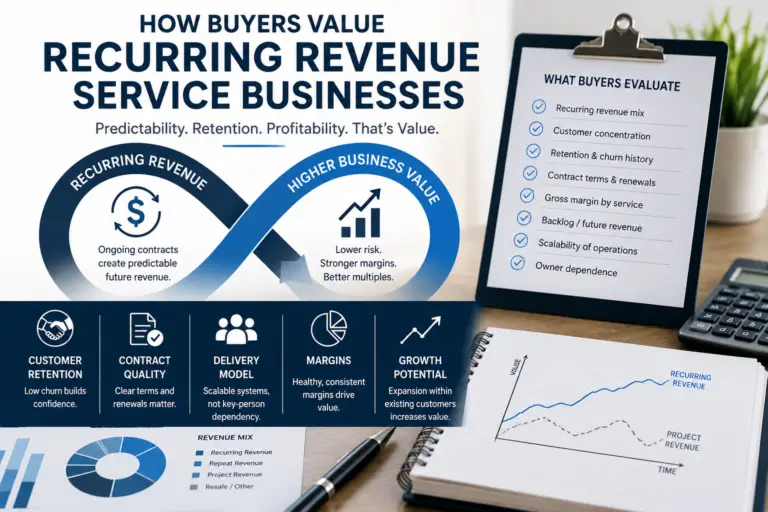
How Buyers Value Recurring Revenue Service Businesses
Recurring revenue can make a service business more valuable, but only when buyers believe the revenue will continue after the sale. A monthly invoice is not enough. Buyers want to understand the contract, the customer relationship, the renewal pattern, the service delivery model, and the margin attached to that revenue.
Plain-English definition
A recurring revenue service business earns revenue from customers who pay on an ongoing basis for services they continue to need. This can include managed IT, cybersecurity monitoring, cloud support, compliance programs, inspection schedules, maintenance contracts, outsourced operations, and other services where customers buy repeatedly rather than once.
Recurring revenue is different from repeat revenue. Recurring revenue is usually contract-based or subscription-like. Repeat revenue may come from the same customers over time, but without a formal recurring contract. Both can be valuable, but buyers underwrite them differently.
When it matters
This matters when a seller wants buyers to pay more than a basic service-company multiple. Buyers may pay more for recurring revenue because it lowers the perceived risk of future revenue loss. It can also make the business easier to finance because lenders and buyers can see a more predictable revenue base.
It matters most in businesses where the line between recurring, repeat, and project revenue is blurry. MSPs, cybersecurity firms, cloud services companies, implementation partners, and compliance services firms often have a mix of monthly contracts, projects, resale, and one-time work. Buyers will not assign the same value to all revenue.
How buyers think about it
Buyers separate revenue into categories before they assign value. A dollar of recurring managed services revenue is usually more valuable than a dollar of project revenue, but only if the recurring revenue has a good margin, strong retention, and a clear delivery model.
Revenue Type | Buyer View |
Contracted recurring revenue | Usually, the most valuable is when retention, margins, and contracts are strong. |
Repeat customer revenue | Valuable, but buyers will study frequency, history, and customer behavior. |
Project revenue | It can be profitable, but buyers discount it because it must be replaced. |
Hardware/software resale | Usually lower value unless it drives sticky service revenue. |
One-time cleanup or unusual revenue | Often excluded or heavily discounted in valuation. |
Buyers will also study gross margin by revenue type. Recurring revenue with poor margins may not help valuation much. A high-margin recurring service line that improves customer retention can materially improve buyer interest.
Example
A cloud services firm has $8 million in revenue and $1.2 million of EBITDA. On the surface, it looks like a solid business. But the revenue mix matters. If $5 million is one-time migration work, $2 million is recurring cloud management, and $1 million is resale, a buyer will not treat the entire $8 million as recurring. The buyer may value the recurring cloud management revenue more highly and apply a lower view to the migration backlog.
The same business would be more attractive if $5 million were recurring managed cloud support, $2 million were repeat expansion projects from existing customers, and $1 million were new project work feeding the managed services base.
Common seller mistake
The common mistake is to call everything recurring just because customers come back. Buyers will ask whether revenue is contractually recurring, behaviorally repeatable, or just historically common. Those are not the same thing.
Another mistake is ignoring the gross margin. Buyers do not only ask whether revenue repeats. They ask whether it can be repeated profitably and whether the company has the staff, tools, and processes to deliver the work without heroics.
What to prepare
- Revenue by customer and service line for at least three years.
- A clear revenue segmentation: recurring, repeat, project, resale, and one-time.
- Gross margin by service line.
- Contract terms, renewal dates, and cancellation rights.
- Customer retention and churn history.
- Backlog or contracted future revenue.
- Pricing model and history of price increases.
- Delivery team capacity and utilization.
- Explanation of how project work creates future recurring revenue.
Useful Articles
- What Buyers Look for in Founder-Led B2B Services Companies
- Customer Concentration and Business Valuation
- Owner Dependence and Business Value
- EBITDA vs SDE in Lower Middle Market M&A
- MSP Valuation Guide
- Cloud Services Valuation Guide
- Compliance Services Valuation Guide
Next Steps
If your business has a mix of recurring, repeat, and project revenue, it is worth organizing the story before speaking with buyers. A clean revenue bridge can make the business easier to understand and harder to discount.