
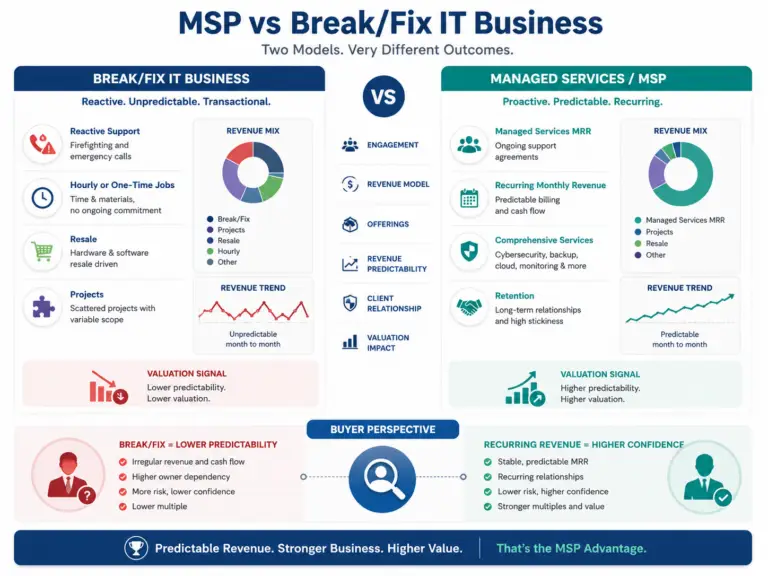
MSP vs Break/Fix IT Business
Buyers generally pay more for revenue they believe will continue. Break/fix IT support can be profitable, but it is harder to underwrite because the buyer must keep finding the next problem, project, or urgent client need. Managed services revenue gives buyers more confidence because it is ongoing, measurable, and tied to a continuing client relationship.
Plain-English definition
An MSP provides ongoing IT services under recurring agreements. A break/fix IT business responds when something breaks or when a customer has a specific need. Many companies have both. The buyer’s job is to separate contracted recurring revenue from repeat customer behavior, projects, resale, and one-time work.
When it matters
This matters when a seller wants buyers to value the company like an MSP rather than a local IT services shop. A company can call itself an MSP, but buyers will look at the revenue mix. If most revenue is from hourly support, one-time projects, or hardware resale, buyers will not underwrite it the same way they underwrite contracted managed services.
How buyers think about each revenue type
- Managed services MRR: usually the most valuable if contracts, retention, and margins are strong.
- Block hours or recurring support bundles are useful, but buyers will study whether usage and renewals are predictable.
- Project revenue can be attractive if it comes from existing clients and feeds future MRR, but buyers discount it if it must be replaced.
- Break/fix revenue: usually lower value because it is reactive and less predictable.
- Hardware/software resale often has lower margins and a lower multiple unless it supports sticky service relationships.
- Emergency work or one-time cleanup is often excluded or heavily discounted in valuation.
Why recurring revenue changes the conversation
Recurring revenue reduces uncertainty. A buyer can review contracts, invoices, renewal behavior, churn, margins, and service load. Project revenue may be profitable, but the buyer needs to understand whether it will repeat. Break/fix work can create revenue. Still, it often depends on urgency, availability, and customer habits rather than a predictable contract.
Example
An IT services firm generates $4 million of revenue. If $3 million is contracted for managed services and $1 million is project work from existing managed clients, buyers may see a true MSP with revenue from expansion. If $1 million is recurring and $3 million is break/fix, hardware, and one-time projects, buyers may still be interested. Still, they will likely apply a lower valuation framework and ask harder questions about future revenue.
Common seller mistake
The common mistake is calling revenue recurring because the same customer buys every year. Repeat customers are valuable, but recurring revenue usually implies a contract, an ongoing obligation, a renewal pattern, and predictable billing. Buyers will make that distinction.
What to prepare
- Revenue segmentation by recurring managed services, block hours, projects, break/fix, resale, cybersecurity, backup, cloud, and one-time work.
- Contract terms and billing frequency for each recurring customer.
- Three-year revenue by customer and service category.
- Gross margin by revenue category.
- Project backlog and history of projects converting into recurring managed services.
- Churn and renewal history for recurring clients.
- Pricing model and any history of price increases.
Related Articles
- MSP & Managed IT Services M&A Advisor
- MSP Valuation Guide
- What Buyers Look for in an MSP
- Preparing an MSP for Sale
- Cybersecurity Revenue in MSP Valuation
- How Buyers Value Recurring Revenue Service Businesses
Next Steps
If your business has a mix of managed services, projects, break/fix, and resale, the revenue bridge should be built before buyers see the company. A clean revenue mix can prevent buyers from discounting the entire business because some revenue is less predictable.