
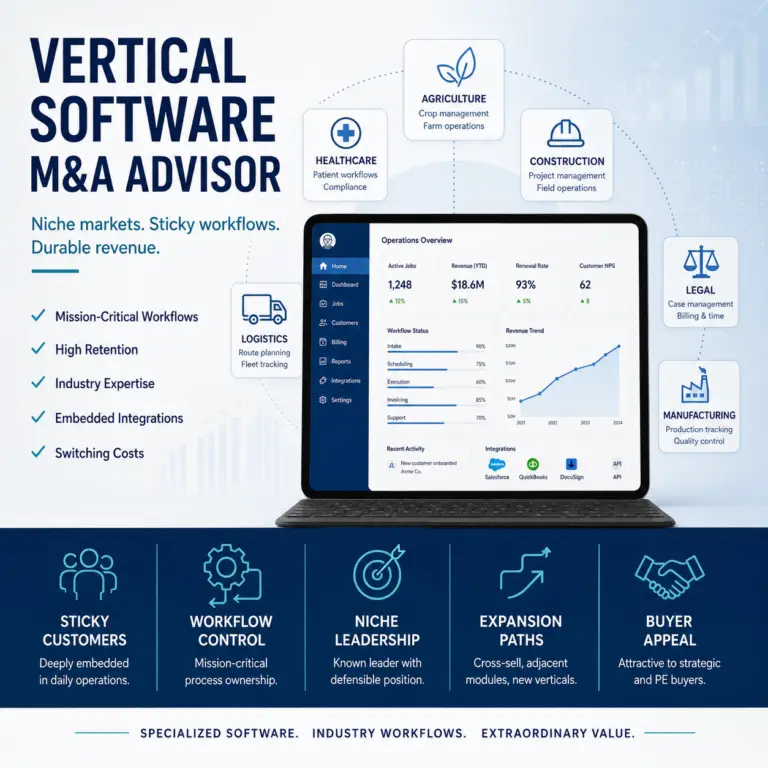
Vertical Software M&A Advisor
Vertical software companies serve a specific industry, workflow, or customer type. They are often attractive to buyers because the product is built around a problem that general-purpose software does not solve well.
A good vertical software business can be very sticky. Customers may depend on the software for daily operations, compliance, reporting, scheduling, billing, payments, field work, customer communication, or industry-specific workflow. When the software becomes part of how customers run the business, buyers usually pay closer attention.
Plain-English definition
Vertical software is software designed for a specific market rather than for every company. Examples include software for agriculture, construction, healthcare, legal, logistics, insurance, field services, manufacturing, automotive, education, government, and other niche industries.
The value is not just that the software is specialized. The value comes from industry knowledge, customer relationships, embedded workflows, domain-specific data, integrations, and a product that is difficult for a general platform to replace.
When it matters
Vertical software positioning matters when a seller wants buyers to understand why the company is more than a small software product. A focused niche can make the business more attractive if the customer problem is real, the workflow is important, and the company has a defensible position in that market.
It matters even more when the market is small but valuable. Buyers may accept a narrower TAM if the company has strong retention, pricing power, and a clear path to owning more of the customer workflow.
How buyers think about vertical software
Buyers usually ask whether the company owns an important workflow inside a specific market. They want to know whether customers see the product as a must-have operating system, a helpful tool, or a replaceable feature.
They will also test whether the market is large enough for the buyer thesis. A vertical software company does not need to serve a huge market, but it needs enough customers, wallet share, and expansion opportunity to justify the price.
What buyers like
- Mission-critical workflows that customers use frequently.
- High retention and low churn within a defined industry.
- Domain-specific features that general platforms do not handle well.
- Customer data or workflow history that increases switching costs.
- Integrations with industry systems, regulators, payment providers, or operating platforms.
- A clear opportunity to expand modules, pricing, services, or customer segments.
- Evidence that the product wins because it fits the vertical, not only because it is cheap.
Example
A software company serving produce growers may not have the broad market size of a horizontal CRM company. But if the product handles labor tracking, compliance records, productivity reporting, and payroll-adjacent workflow that growers need every season, buyers may see a defensible vertical software business. The market is narrower, but the product can be harder to displace.
Common seller mistake
The common mistake is assuming that a niche automatically creates a premium. A niche helps only if the company has a strong position, real customer retention, and a specific reason buyers believe the revenue will continue. A small market with limited growth, high churn, and heavy customization is not automatically attractive.
What to prepare
- Customer count, revenue by vertical segment, and customer tenure.
- ARR or recurring revenue by product/module.
- Gross and net retention by customer cohort.
- Evidence of workflow importance: usage, renewal reasons, implementation depth, or customer references.
- Competitive landscape and why customers choose the product.
- Market size, adjacent markets, and credible expansion paths.
- Product roadmap tied to industry-specific needs.
- List of integrations, data sources, compliance requirements, and domain-specific functionality.
Related Articles
- Software & SaaS M&A Advisor
- SaaS Valuation: ARR vs EBITDA
- What Buyers Look for in SaaS Companies
- Preparing a SaaS Company for Sale
- Strategic Buyers for Software Companies
- Customer Concentration and Business Valuation
- Owner Dependence and Business Value
Next Steps
If you own a vertical software company, the sale story should explain why your niche is valuable, not just small. Buyers need to see the customer problem, the workflow control, and the reason the business is durable.
FAQ
Do vertical software companies need large markets to be valuable?
Not always. A smaller market can still be attractive if the company has strong retention, pricing power, and a meaningful role in the customer workflow.
What scares buyers away from vertical software?
Buyers get concerned when the market is too small, growth has stalled, the product requires heavy customization, or the founder is the only person who understands the customer domain.