
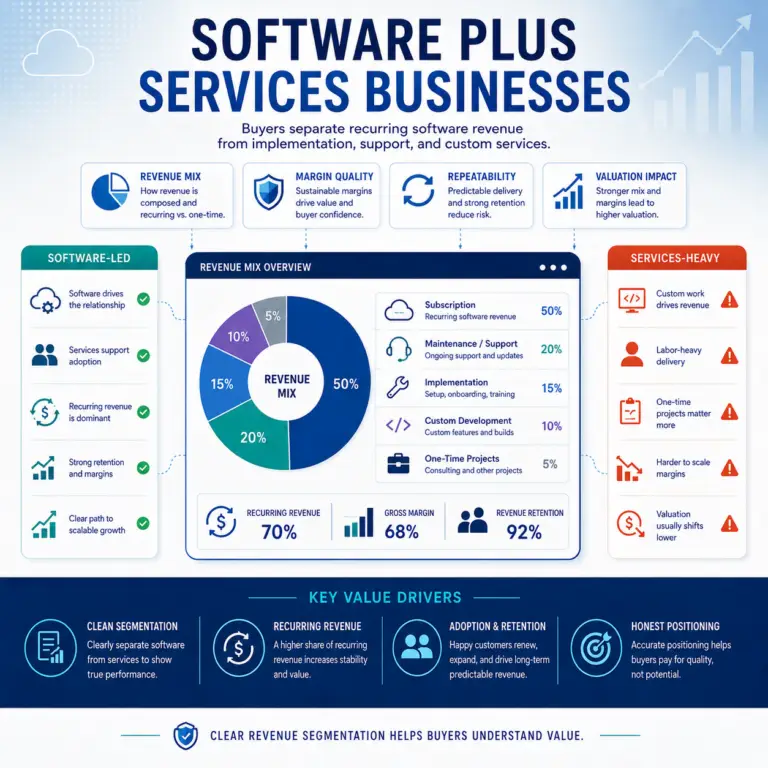
Software Plus Services Businesses
Many lower-middle-market software companies include services. Implementation, onboarding, training, configuration, integrations, support, data migration, and customer success can all be part of a healthy software business. The issue is whether the software drives the relationship or the services do.
Plain-English definition
A software-plus-services business sells software along with services that help customers implement, use, customize, or support the product. Buyers will try to determine whether the company is a scalable software business with necessary services, or a services business using software as part of delivery.
When it matters
This matters when a seller wants a software valuation but a meaningful percentage of revenue comes from professional services, implementation, custom development, or support labor. Services are not automatically bad. In many vertical markets, services help customers adopt the product and increase retention. But services-heavy revenue usually changes the valuation framework.
How buyers think about it
Buyers separate revenue by type. Subscription revenue, maintenance, implementation, customization, support, managed services, pass-through revenue, and one-time projects may all be valued differently. A dollar of recurring software revenue is usually more valuable than a dollar of custom services revenue, but the margin, repeatability, and customer impact matter.
Revenue Type | Buyer View |
Recurring software subscription | Usually most valuable when retention and margins are strong. |
Maintenance/support | Valuable if renewal rates are high and support burden is manageable. |
Implementation/onboarding | Can be positive if it supports adoption and leads to recurring revenue. |
Custom development | Often discounted if it is labor-heavy and customer-specific. |
Managed services around software | Can be valuable if recurring, profitable, and attached to the platform. |
One-time projects | Usually discounted because the buyer must replace them. |
Example
A company has $7 million of revenue. If $5 million is recurring software subscription, $1 million is implementation, and $1 million is support tied to renewals, buyers may see a software-led business. If $2 million is software and $5 million is custom project work, buyers may still be interested, but they will likely value the business more like a technology services firm with product IP.
Common seller mistake
The common mistake is blending software and services revenue and expecting buyers to apply one software multiple to the entire business. Buyers will separate the revenue. If the seller does not do the segmentation first, buyers will usually do it more conservatively during diligence.
What to prepare
- Revenue by software subscription, maintenance, implementation, support, custom development, and other services.
- Gross margin by revenue category.
- Implementation time, onboarding cost, and services capacity.
- Percentage of services revenue tied to new customers versus existing customers.
- Evidence that services improve retention, expansion, or product adoption.
- Custom development backlog and customer-specific obligations.
- Delivery process, documentation, staffing model, and utilization.
- How project work converts into recurring software or support revenue.
How to position it
A software-plus-services company should not hide the services. It should explain why they exist. If services are required to onboard customers, improve retention, or create expansion revenue, they can support the buyer story. If services are really the core business, the seller should position the company honestly and avoid forcing a pure SaaS narrative.
Related Articles
- Software & SaaS M&A Advisor
- SaaS Valuation: ARR vs EBITDA
- What Buyers Look for in SaaS Companies
- Preparing a SaaS Company for Sale
- Legacy Software Company M&A
- How Buyers Value Recurring Revenue Service Businesses
- EBITDA vs SDE in Lower Middle Market M&A
- Owner Dependence and Business Value
Next Steps
If your company has both software and services revenue, build a clean revenue bridge before speaking with buyers. The clearer the mix, the easier it is to defend the valuation story.
FAQ
Are services bad for software valuation?
Not necessarily. Services can improve adoption and retention. They become a concern when they are low-margin, one-time, custom, or the real reason customers buy.
Can a services-heavy software company still sell?
Yes. But buyers may value it using EBITDA and revenue quality rather than a premium SaaS ARR multiple.