
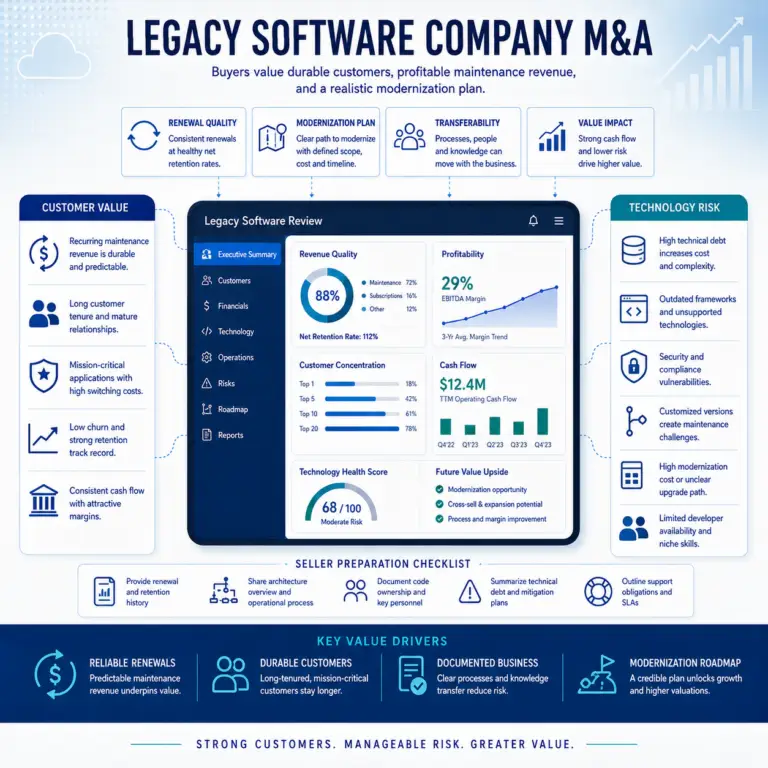
Legacy Software Company M&A
Legacy software companies can still be valuable. Buyers do not automatically reject older technology if the customer base is durable, maintenance revenue renews, and the product solves an important problem. But they will underwrite the business differently from a modern cloud-native SaaS company.
Plain-English definition
A legacy software company usually has older architecture, license and maintenance revenue, on-premise installations, single-tenant hosting, older development frameworks, or a product that has not been fully migrated to a modern SaaS model. Legacy does not mean bad. It means buyers will study modernization risk and customer durability carefully.
When it matters
This matters when a seller has strong profits and loyal customers, but the technology story is not clean. A buyer may still be interested, especially if customers renew year after year and the software is embedded in operations. However, the buyer will ask what investment is needed after closing.
How buyers think about legacy software
Buyers separate customer value from technology risk. They may like the customer base, market position, and maintenance revenue while still discounting for technical debt, support burden, limited developer availability, security concerns, or the cost of cloud migration.
The best legacy software stories are honest. A seller does not need to pretend the product is modern SaaS. The seller needs to explain why customers stay, how support works, what modernization has been done, and what a buyer would need to invest.
What buyers like
- High maintenance renewal rates and long customer tenure.
- Mission-critical product usage despite older technology.
- Low churn and limited competitive displacement.
- Profitable operations and strong cash flow.
- Clear technical documentation and a team that understands the codebase.
- A practical modernization roadmap rather than vague promises.
- Customers who would benefit from new modules, cloud migration, integrations, or better packaging.
What buyers worry about
- One developer or founder is the only person who understands the product.
- Unsupported frameworks, outdated databases, or difficult deployment environments.
- Security vulnerabilities or customer requirements the company cannot meet.
- High support burden from custom versions or customer-specific modifications.
- Declining maintenance revenue or customers planning to replace the product.
- Cloud migration cost that may exceed the value of the customer base.
Example
A 25-year-old vertical software company has flat revenue but high EBITDA and customers that have renewed maintenance for a decade. Buyers may not value it like a high-growth SaaS company, but they may still see value if the product owns a niche workflow and the customer base is stable. The valuation conversation will focus less on growth hype and more on retention, cash flow, modernization cost, and transferability.
Common seller mistake
The common mistake is describing a legacy company as SaaS because the product is hosted or billed annually. Buyers will look at architecture, deployment, updates, customization, support model, renewal terms, and gross margin. It is better to be precise than to force the company into a SaaS label that buyers will reject.
What to prepare
- License, maintenance, support, hosting, and services revenue by customer.
- Maintenance renewal history and churn by year.
- List of on-premise, hosted, single-tenant, and multi-tenant customers.
- Technical architecture summary and codebase ownership.
- Custom versions, customer-specific modifications, and support obligations.
- Known technical debt and modernization roadmap.
- Security, backup, disaster recovery, and compliance posture.
- Developer roles, contractor dependencies, and documentation status.
Related Articles
- Software & SaaS M&A Advisor
- SaaS Valuation: ARR vs EBITDA
- What Buyers Look for in SaaS Companies
- Preparing a SaaS Company for Sale
- Software Plus Services Businesses
- Owner Dependence and Business Value
- Customer Concentration and Business Valuation
- Strategic Buyers for Software Companies
Next Steps
If you own a legacy software company, the sale story should be built around customer durability, profit, and a realistic technology plan. Buyers can accept imperfection, but they need to understand the risk.
FAQ
Can a legacy software company sell?
Yes. Legacy software companies can sell when customers are sticky, revenue is profitable, and the technology risk is understood.
Will buyers discount legacy technology?
Often, yes. The discount depends on retention, technical debt, support burden, security risk, and the investment required after closing.