
What Buyers Look For in an Attractive Company
Buyers don’t pay for what a company could become. They pay for what it reliably produces today — and how easily they can grow it after you.
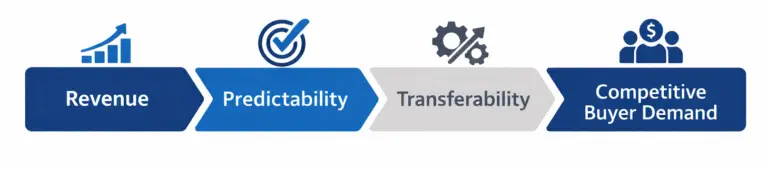
Multiples aren’t assigned first. They’re earned through predictability, clean operations, and low risk. The strongest exits happen when a business is positioned so sophisticated buyers are confident they can step in and continue moving forward.
Buyers don’t just evaluate performance — they also evaluate how the selling process is being managed.
What Sophisticated Buyers Pay More For
Predictable, Recurring Revenue
Buyers value stability. Subscription revenue, repeat clients, or long-term contracts reduce risk and make future cash flow easier to forecast. The more predictable the revenue stream, the stronger buyer interest tends to be.
Low Owner Dependency
If the business depends heavily on the founder for sales, delivery, or critical relationships, the risk increases. Buyers look for businesses that can operate successfully without the owner being involved every day.
Clean, Verifiable Financials
Serious buyers expect financial records that hold up during due diligence. Clear reporting, consistent margins, and organized books build confidence and shorten deal timelines.
Diversified Customer Base
Revenue concentration makes buyers nervous. Companies with a broad customer base are more attractive because no single client can significantly affect performance.
Repeatable Sales Process
Businesses that grow through a consistent sales system are easier to scale after acquisition. A predictable pipeline is more valuable than founder-driven relationship selling.
Stable or Improving Margins
Healthy margins demonstrate operational control and pricing power. Buyers pay more when they see evidence that profitability is sustainable.
Clear Growth Path After Acquisition
Buyers want to see opportunity. A company that can reasonably grow with additional resources, sales capacity, or strategic support attracts stronger offers.
Operational Structure and Team
A business supported by capable employees, documented processes, and clear responsibilities feels safer and more transferable.
The best exits usually start 12–24 months before going to market.
What Sophisticated Buyers Avoid
Businesses that rely almost entirely on the founder to run day-to-day operations.
Financial results that cannot be clearly supported during due diligence.
Early-stage or pre-revenue ideas where demand has not yet been proven.
These aren’t judgments — they’re simply the realities of how experienced buyers evaluate risk.
Minimum Foundations Buyers Expect
Most professional and institutional buyers focus on operating companies that already demonstrate real market demand and meaningful scale. Typical baseline expectations include:
Consistent revenue history
Real customers and repeat business
Financial records that support diligence
Systems or team structure beyond a single founder
Companies that have reached roughly $ 3 M in revenue and have established recurring income generally attract the strongest buyer interest.
If your company isn’t there yet, that’s not a problem — it usually means the highest-value buyers are still ahead of you, not behind you.
How Attractiveness Impacts Valuation
Valuation isn’t a fixed number tied only to revenue. Buyer perception and risk play a major role.
Founder-dependent companies often see limited buyer pools and conservative offers.
Structured, predictable companies attract more competition and stronger terms.
Strategic fits can command premium outcomes when buyers see a clear fit into the existing strategy.
The goal is not simply to “get a higher multiple.” The goal is to create competitive buyer demand.
Why This Matters Before You Go to Market
Many owners focus first on valuation ranges. In reality, buyer interest drives valuation — not the other way around.
When a business is prepared and positioned correctly, offers tend to be stronger, terms cleaner, and the process faster. The difference often comes down to how buyers perceive risk and opportunity during their first impression.
Wondering How Buyers Would View Your Company Today?
If you’re thinking about selling — now or in the next few years — a straightforward conversation about how buyers are likely to evaluate your business can help you make better decisions early.
A single inbound inquiry or unsolicited offer rarely reflects the full market value of a company.
The strongest exits rarely happen by accident. They’re usually the result of understanding what buyers want before going to market.
Schedule a confidential conversation to discuss how your company would be viewed by today’s buyers.
Looking for market valuation ranges? Visit the Valuation Insights page for the current market context.